
Tasked with finding notable alumni to profile for the annual Wisconsin China Resource spring student workshop, research assistant Andrew Liu (Class of 2024, History) soon faced a quandary. He found a set of path-breaking UW-Madison alumni to highlight—people whose careers in China and education in the early 1900s in Madison exemplified the Wisconsin Idea. However, Liu wanted to connect the alumni stories to an early debate within China about the purpose of cultural exchange. And he approached this dilemma as someone actively involved in theater.
This led to a path-breaking idea of its own: turning the annual “Chinese Badgers/Badgers in China” event into a workshop set within a dramatic performance.
“It will be unlike anything we have ever done before,” said Center for East Asian Studies Assistant Director Laurie Dennis, a member of the workshop planning team. “The dramatic nature of the material lends itself well to what Andrew is wanting to do. And it’s not every day that you get a student researcher who can also write you up a play.”
The story of John Earl Baker
As he launched his research in the fall, Liu soon became interested in the fascinating story of John Earl Baker (Class of 1906, Philosophy), a native of rural Waukesha County, Wisc., who led famine relief in China and oversaw the construction of hundreds of miles of roads. During World War II, Baker was named Inspector General of the Burma Road, the pipeline for supplies into China to circumvent the Japanese blockade. His 1957 obituary in the New York Times noted that, “In his many years with relief agencies battling plague, famine and pestilence in China it was said of Dr. Baker that, directly or indirectly, he had saved as many lives as any other human being.”
Liu’s research also turned up connections between Baker and a fellow Badger, Zhou Yichun (1910 master’s degree, Education). Zhou was in the first group of seven Chinese students to receive degrees—three bachelor’s and four master’s degrees—from UW-Madison and he went on to become a founding president of China’s Tsinghua University. He also served on a famine relief commission with Baker.
The catalyst of a 19th-century debate
These stories and relationships got Liu thinking more generally about the value of student exchanges. And this led to his novel idea for the 2026 “Chinese Badgers/Badgers in China” workshop, an event designed to offer a venue for students to present the stories of UW-Madison alumni connected to China.
“I wanted to do something on study abroad and I wanted to go way back,” he said.
Liu recalled a book he had received from his father while he was attending high school in China and preparing to begin his own studies abroad at UW-Madison. The book was about a debate in the late 1800s between two Chinese scholars: Chen Lanbin 陳蘭彬, 1816-1895, a conservative government official concerned about the corrupting influence of American culture, and Yung Wing 容闳, 1828-1912, a reformist educator intent on increasing the number of Chinese students studying in, and learning from, the U.S.
As an active member of the “Saying Theatre” student organization at UW-Madison (威斯康辛大学戏言剧社), and as a director working on the group’s spring production, Liu also began to see the debate on student exchange as something that might work well as a theatrical performance. Liu suggested to the planning team for the 2026 student “Chinese Badgers/Badgers in China” workshop that he could write a narrative to frame the student presentations on early Badgers.
The planning team agreed that he should proceed.
“I started to write a brief intro, and I couldn’t stop,” he said.
From the beginning, Liu envisioned himself in the role of the conservative Chen Lanbin. And he soon recognized his foe in fellow history student Houye Lyu (Class of 2026).
“You look like the person my character hates!” Liu told Lyu.
April 7 workshop is the fourth annual
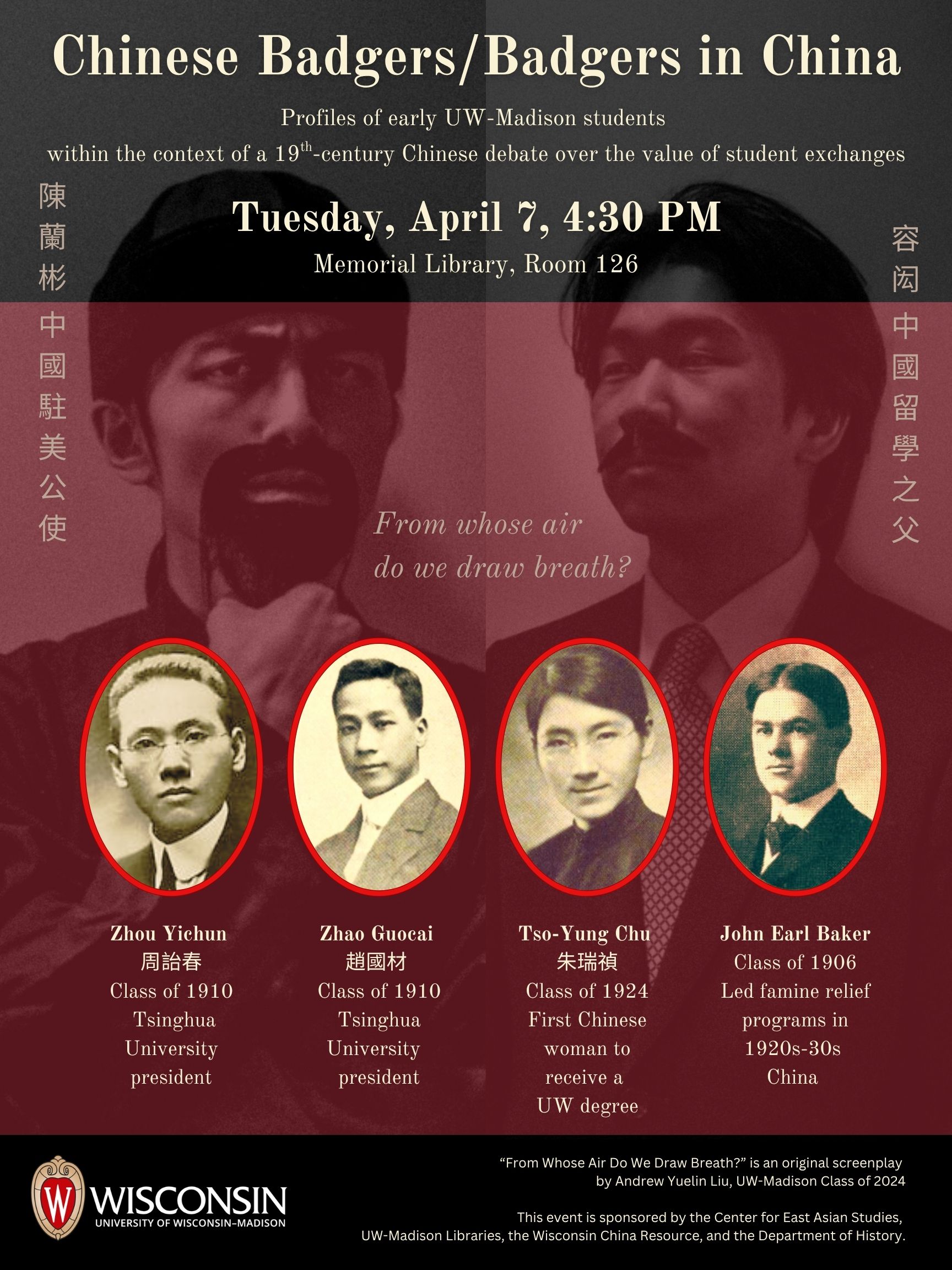 The two appear in costume in the background of the event poster for “Chinese Badgers/Badgers in China.” The script has them arguing about nationalism and funding, whether cultural exchange favors one nation over another, and the impact of the Chinese Exclusion Act (which caused Yung Wing’s American citizenship to be revoked). Chen Lanbin calls America “hostile to foreigners.” Yung Wing implores him to recognize that “Modernity is nigh, prosperity is near!” They both peer down from the Afterlife to study how Chinese students are succeeding in Wisconsin.
Liu and Lyu will perform Tuesday, April 7, starting at 4:30 pm in Memorial Library’s room 126 (on the main floor, near the Langdon Street entrance). Liu’s original screenplay, “From Whose Air Do We Draw Breath?” will introduce and offer commentary on the following profiles of pioneering early Badgers, which will be presented by current undergraduates:
- Zhou Yichun 周詒春, Master’s Degree in Education, 1910. Presented by accounting and history major Sidney Wang.
- Zhao Guocai 赵国材, Political Science Bachelor’s Degree in 1910 and Master’s Degree in 1911. Presented by political science/international studies/history major Tony Jing.
(Zhou and Zhao, who were both in the first cohort of Chinese students to receive UW-Madison degrees, returned to China and worked together to transform a preparatory school in Beijing into Tsinghua College, which remains to this day a premier Chinese university.)
- Tso-Yung Chu 朱瑞祯, Bachelor’s Degree in Bacteriology in 1924 and the first Chinese woman to receive a UW-Madison degree. Presented by classics major Arden Sigmund.
- John Earl Baker, Bachelor’s Degree in Philosophy, 1906. Presented by business major Rowan Bickett.
The spring student workshop, which dates to 2023, is an annual collaboration between the Center for East Asian Studies’ Wisconsin China Resource and UW Madison Libraries’ East Asian Studies Librarian Anlin Yang. The workshop program is designed both to showcase the rich history of early UW-Madison connections with China, and to offer current students opportunities for research and presentations.
More about the workshop can be found on the Wisconsin China Resource website.

